Founder
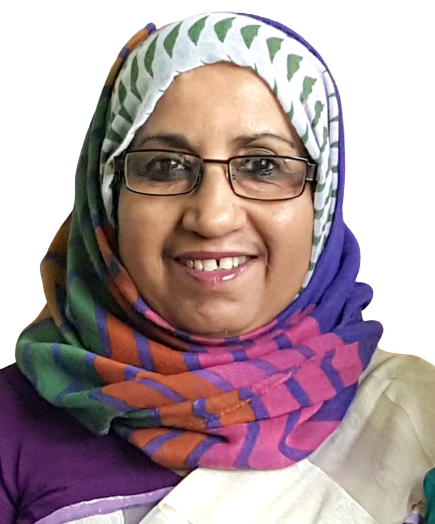
About Professor Haseena Khan
Dr. Haseena Khan obtained her General School Certificate (GCE “O” Level) under the University of Cambridge from St. Francis Xavier’s School in January 1971. She completed her HSC from Holy Cross College, Dhaka, in 1974. She obtained her B.Sc. (Hons.) in Biochemistry from the University of Dhaka in 1978 and her M.Sc. in Biochemistry in 1980. She was placed in the first class in both the B.Sc. and M.Sc. programs. She then went on to complete her Ph.D. in Molecular Biology from the University of Sussex, England, in 1982 under a Commonwealth Scholarship. At that time, Dr. Khan was already a lecturer in the Department of Biochemistry and obtained study leave to pursue her Ph.D. program. Professor Khan has also worked as a research scientist in renowned laboratories in Toulouse, France, and Montreal, Canada.
She joined the Department of Biochemistry and Molecular Biology (then the Department of Biochemistry), University of Dhaka, as a lecturer in January 1982. She has been working as a Professor in the same department since 1995. Because of her extensive experience in teaching and research in molecular biology, she was appointed the first Chairperson of the Department of Genetic Engineering and Biotechnology, University of Dhaka, in 2001. She served as Chairperson for four and a half years and was responsible for establishing a strong foundation for the new department, which now attracts some of the best students in the country.
She has been involved in biological research using molecular biology and genetic engineering tools since 1982, when this discipline was still in its infancy. She has attracted research funding from several national and international agencies, including the USDA (U.S. Department of Agriculture), ICGEB (International Centre for Genetic Engineering and Biotechnology), IJO (International Jute Organization, now called IJSG, International Jute Study Group), the Ministry of Science and Technology, and the Ministry of Education, Government of the People's Republic of Bangladesh.
She was one of the team leaders of the Jute Genome Sequencing Project, funded by the Ministry of Agriculture. She is also known for her leadership in decoding the genome of Tenualosa ilisha (the Hilsa fish) from the River Padma. She was awarded the Independence Day Award, the highest state award given by the Government of Bangladesh, for her contribution to research and training.
In order to broaden the genetic base of jute, it was necessary to implement efficient jute breeding and transformation programs for developing stress-tolerant jute. Jute cannot be regenerated after genetic transformation because it is recalcitrant to tissue culture. In this context, Dr. Khan's group successfully developed a tissue-culture-independent method for efficient jute transformation. Her group has identified a number of genes that are differentially expressed when jute is grown at temperatures below its base temperature of 20°C. Her research group has also successfully used artificial miRNA and hp-siRNA to downregulate four genes of the lignin biosynthetic pathway. Reducing the lignin content of jute has tremendous commercial implications, since lignin poses a number of challenges in developing value-added jute products.
She has served as one of the two scientists on the National Executive Committee on Biotechnology and was also a member of the committee responsible for drafting the National Biotechnology Policy. She is one of the four women Fellows of the Bangladesh Academy of Sciences and is a Fellow of the TWOWS (Third World Organization for Women in Science). She is a member of the Governing Body of the National Institute of Biotechnology. She has contributed chapters to three books on agricultural biotechnology. She was approached by McNeil Publishers, USA, for a Bangla-English glossary on Biotechnology and a Bangla-English glossary on Avian Flu, both of which she successfully completed.